
Reliable property research in Malaysia starts with knowing which website answers which question. Listing portals show asking prices, but they cannot confirm title conditions, ownership, planning approval, or the final price paid for a comparable property. Government databases, professional directories, market reports, and local sources each cover a different part of the picture.
This guide identifies the most useful Malaysian real estate resources for buyers, sellers, investors, landlords, and expatriates, with added attention to Kota Kinabalu and Sabah. It covers market data, land information, professional verification, listings, planning documents, financing context, tax guidance, and local industry news.
The best approach is to use several Malaysian real estate resources together. Start broadly, compare what you find, and then confirm the details through the relevant Sabah authority or qualified professional before signing an agreement or paying a deposit.
How to Use Malaysian Real Estate Resources Properly
Online property research is more dependable when sources are assigned clear jobs. Official data is strongest for statistics, legislation, tax rules, and government procedures. Portals help buyers discover listings and compare asking prices. Professional directories support registration checks, while market reports and local news add interpretation and context.
For Sabah, the distinction is especially important. Some national Malaysian real estate resources focus on Peninsular Malaysia, while Sabah has its own land administration, state laws, legal profession, and local authorities. Check the geographic scope before applying any guidance to Sabah property.
Quick Reference: Which Resource Should You Use?
| Research question | Best starting resource | What it can tell you | Main caution |
| What is happening in the property market? | NAPIC/JPPH | Transactions, property stock, price indices, launches, and market reports | Broad data does not replace a property-specific valuation |
| How do I research a Sabah title or land matter? | Sabah Lands and Surveys Department | Land administration services, title references, quit rent, and survey-related services | A lawyer should interpret searches and title conditions |
| Where can I read Sabah legislation? | Sabah State Attorney-General’s Chambers | State ordinances, enactments, and amendments | Legislation may require professional interpretation |
| How can I check a Sabah law firm? | Sabah Law Society | Advocate and law-firm directory information | Confirm the current practising status and relevant experience |
| Where can I compare properties for sale or rent? | Local and national listing portals | Asking prices, photos, property types, locations, and agent contacts | Listings can be duplicated, outdated, or incomplete |
Official Malaysian Property Market and Regulatory Sources
NAPIC and JPPH: Transaction Data, Supply, and Price Trends
The National Property Information Centre is one of the most important Malaysian real estate resources for evidence about the Malaysian market. NAPIC operates within the Valuation and Property Services Department, commonly identified by its Malay abbreviation, JPPH. Its publications cover transaction volumes and values, property stock, overhang and unsold units, new residential launches, occupancy, price indices, and regional market conditions.
NAPIC publishes national and state-level tables, including Sabah transaction data. Its publication page brings current quarterly and annual releases together across residential, commercial, industrial, agricultural, and development-land sectors.
LPPEH: Checking Estate Agents, Valuers, and Property Managers
The Board of Valuers, Appraisers, Estate Agents and Property Managers regulates these professions and maintains professional registers. Use it to verify registration details rather than relying on a name card or social-media profile.
Registration checks are valuable when a buyer is approached online. Confirm the individual, firm, and role being claimed. A real estate negotiator works under a registered estate agency and should not be presented as an independent estate agent.
HASiL: RPGT and Stamp-Duty Information
HASiL provides official Real Property Gains Tax guidance covering rate categories, acquisition and disposal dates, exemptions, filing procedures, and the responsibilities of the parties. It is one of the key Malaysian real estate resources for a sale or transfer.
HASiL also maintains stamp-duty information. Since tax treatment varies by citizenship, residence, ownership structure, holding period, exemptions, and transaction type, obtain transaction-specific advice rather than relying on a headline rate.
Bank Negara Malaysia: Financing Context and Consumer Information
Bank Negara Malaysia does not approve individual mortgages, but its Financial Stability Review archive explains housing-loan conditions, household borrowing, and financial-system risks. Compare actual financing offers directly with banks.
TEDUH: Useful National Housing Information With a Sabah Warning
The federal TEDUH housing portal provides information about public and private housing, developers, buyer guidance, and project status. It can be a useful starting point for projects within its stated coverage.
The warning is important: parts of TEDUH’s private-housing project-status service state that they cover Peninsular Malaysia. A Sabah development should instead be checked through the relevant Sabah ministry, local authority, developer documents, approvals, permits, and legal advice.
Sabah-Specific Land, Legal, and Planning Resources
Sabah Lands and Surveys Department
The Sabah Lands and Surveys Department, or JTU, is central to Sabah land administration. Its site links to title-reference, quit-rent, survey, and land-information services, making it one of the essential Malaysian real estate resources for Sabah property.
JTU’s online tools can help identify title formats and available services. Buyers should still have a Sabah lawyer conduct the required searches and explain tenure, conditions, restrictions, charges, caveats, and other entries before the purchase becomes unconditional.
Sabah State Attorney-General’s Chambers
The Sabah Laws database provides access to state ordinances and enactments, including the Land Ordinance. Use it to locate the governing law and later amendments.
Sabah Law Society Directories
Sabah has its own legal profession. The Sabah Law Society law-firm directory is the proper starting point for checking firms practising in the state and reviewing professional information.
A directory listing is a starting point. Ask whether the lawyer regularly handles Sabah conveyancing and the property type involved, and confirm fees, disbursements, scope, and responsibility for searches in writing.
DBKK Planning Documents for Kota Kinabalu
For Kota Kinabalu property, the DBKK download centre is a practical local source. It includes planning forms, selected by-laws, Pelan KK 2035, and draft local-plan material, adding local depth to other Malaysian real estate resources.
Planning material can help a buyer understand intended land use, road networks, and the direction of an area. It is not a guarantee. Confirm current zoning, approvals, permitted use, and property-specific restrictions with the correct authority and professional team.
Official Sabah MM2H Information
International buyers considering long-term residence should use the official Sabah MM2H portal for programme terms, application procedures, categories, licensed companies, and property conditions.
Sabah MM2H participation and property ownership are related but separate. Recheck immigration eligibility, programme property obligations, foreign-purchase rules, financing, title eligibility, and tax requirements before applying or buying.
Property Listing Websites for Malaysia and Sabah
Start With a Focused Kota Kinabalu Property Search
A locally focused search reduces noise. Faye Robert Property’s Kota Kinabalu property search allows buyers to review homes, condominiums, land, commercial property, rentals, and developments across Kota Kinabalu and nearby Sabah locations. It is a practical starting point for identifying properties that match a defined budget, area, status, and property type.
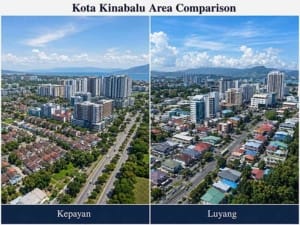
Buyers who are new to the city can also review the guide to the best areas to live in Kota Kinabalu. Area research matters because similar properties can differ greatly in access, surroundings, traffic, facilities, management, and rental demand.
PropertyGuru and iProperty
Large portals help compare asking prices and inventory. PropertyGuru Malaysia and iProperty Malaysia both carry sale, rental, and project information for Sabah and Kota Kinabalu.
These sites are useful Malaysian real estate resources, but their listings are advertisements. Properties may be duplicated, unavailable, or described differently by separate agents. Use portal data to identify options and comparables, then verify floor area, tenure, parking, charges, furnishing, and availability.
Property Hunter for East Malaysian Coverage
Property Hunter has a strong East Malaysian identity and carries listings, developments, agent information, and industry content. It provides another view of Sabah inventory.
EdgeProp for Listings, News, and Past Transactions
EdgeProp’s past-transaction search supplements listings with transaction information, project pages, area data, and property news. It is most useful where enough recorded activity exists for comparison.
Past prices still require interpretation. Date, floor level, orientation, condition, parking, tenancy, title status, and the parties’ circumstances can affect a deal. A recorded transaction is evidence, not an automatic valuation.
Compare New Launches and Subsale Property Differently
New developments and completed resale properties produce different evidence. Developer pages show plans, facilities, and target dates, while subsale listings can show actual units, charges, and how a development functions after occupation.
The guide to new-launch and subsale property in Kota Kinabalu explains these differences. Buyers can also compare landed property versus condominiums in Kota Kinabalu. Each choice changes the records, risks, costs, and comparisons that matter most.
Independent Research, Industry Sources, and Property News
Knight Frank Malaysia Research
Major consultancy reports add professional interpretation to official statistics. Knight Frank Malaysia research publishes periodic reviews of residential and commercial property performance, including coverage of Sabah and Sarawak. These reports are useful Malaysian real estate resources for understanding supply, demand, investment activity, rents, office markets, retail conditions, and regional trends.
SHAREDA and the Sabah Development Industry
The Sabah Housing and Real Estate Developers Association represents developers and participates in industry discussion. Its website can help readers identify association activity, member perspectives, events, and policy matters affecting housing and real estate development in Sabah.
Established Property and Business News
Established property and business media can flag launches, corporate transactions, infrastructure announcements, policy changes, and market sentiment. Strong reporting names sources, provides dates, and distinguishes confirmed approvals from proposals.
Use news as an alert system, then return to the underlying authority, filing, plan, or report. This keeps Malaysian real estate resources in the right order: commentary identifies the issue, while primary material verifies it.
How to Judge Whether a Property Website Is Reliable
Good Malaysian real estate resources identify the publisher, purpose, date, and geographic coverage. Before relying on a page, consider who produced it, what role that organization plays, and whether the material is official data, independent analysis, or promotion.
- Check the publication and effective dates. An older page may describe rules or market conditions that have changed.
- Confirm the jurisdiction. Look for a clear statement that the information applies to Sabah, not only Peninsular Malaysia.
- Find the original source. A summary should lead back to the law, official announcement, data table, approved document, or regulator.
- Separate asking prices from completed transactions. They answer different questions.
- Identify advertising and sponsored material. Promotional content can be useful, but it should be treated as a claim to verify.
- Check names and registration details independently before sending identity documents, signing forms, or transferring money.
Be cautious with confident statements that lack dates, sources, or qualifications. Rules can vary by title, location, nationality, property type, transaction structure, and government approval.
A Practical Online Research Process for Sabah Property
This process turns scattered Malaysian real estate resources into a workable due-diligence sequence. It supports an initial review but does not replace legal, valuation, building, financing, tax, or planning advice.
- Define the purchase purpose, preferred areas, property type, budget, financing needs, and timing.
- Use local and national portals to collect a short list and compare asking prices, sizes, facilities, and availability.
- Review NAPIC data and independent reports to understand the wider market and recent direction.
- Research the area through DBKK documents, maps, site visits, and local knowledge.
- Verify the estate agency, negotiator, lawyer, valuer, and other professionals involved.
- For a development, check the developer, approvals, sale permit, construction position, contractual dates, and the status of titles.
- Ask a Sabah lawyer to conduct the appropriate title and legal searches before the transaction becomes unconditional.
- Confirm financing directly with banks and obtain a full estimate of purchase costs. The guide to the cost of buying property in Kota Kinabalu can help prepare the first budget.
- Foreign buyers should review the current foreign buyer property rules in Sabah and obtain advice on approval, title eligibility, minimum price rules, financing, immigration, and tax.
- Recheck critical facts immediately before signing, paying a deposit, or releasing funds.
Online research should narrow the field and expose questions early. Formal checks must then confirm the points affecting ownership, use, value, cost, and completion.
Common Mistakes in Online Property Research
The most common mistake is asking one website to do every job. Even strong Malaysian real estate resources have limits: a portal cannot certify title, an industry body cannot approve a project, and an old article cannot confirm a current rule.
Other mistakes include comparing undated asking prices, assuming all units are equivalent, accepting marketing measurements without documents, relying on screenshots, and treating proposed infrastructure as completed. Never send a deposit before confirming the property, agency, recipient, and written terms.
Foreign purchasers also risk mixing federal, Peninsular Malaysia, and Sabah requirements. Confirm Sabah-specific land, legal, and approval questions locally, and resolve conflicting information through the responsible authority and professional advice.
How Faye Robert Can Assist With Sabah Property Research
Online research works better when connected to current local inventory. Faye Robert can help buyers identify Sabah properties, compare locations and developments, arrange viewings, clarify listings, and communicate with owners, developers, agents, lawyers, and other parties.
She can help clients select the relevant Malaysian real estate resources and identify questions requiring a lawyer, valuer, lender, tax professional, immigration adviser, surveyor, engineer, or government authority. This keeps real estate assistance separate from regulated professional advice.
Frequently Asked Questions
What is the best website for Malaysian property transaction data?
NAPIC is the strongest official starting point for transaction tables, stock, price indices, and market reports. Project-level tools may be easier to search, but NAPIC should remain among the core Malaysian real estate resources used for market context.
Where can I find official Sabah land and title information?
Start with the Sabah Lands and Surveys Department for title references, quit-rent enquiries, land information, and survey-related services. A lawyer should conduct and interpret searches for an actual purchase.
How can I check whether a Sabah property agent or lawyer is registered?
Use LPPEH resources for estate-agency, valuation, and property-management registration, and the Sabah Law Society directory for advocates and law firms. Confirm the person, firm, status, and role.
Are prices on property portals official market values?
No. Portal prices are asking prices supplied by advertisers, not official valuations or proof of completed transactions. Compare several sources and obtain a professional valuation where value is material.
Does TEDUH confirm the status of a Sabah development?
TEDUH provides useful federal housing information, but parts of its private-project service cover Peninsular Malaysia. Check a Sabah development through Sabah authorities, developer documents, permits, title records, and legal advice.
Which resources are most useful for foreign buyers?
Foreign buyers should combine official Sabah MM2H information where relevant, land and legal sources, current listings, bank and tax guidance, and Sabah professional advice. No single group of Malaysian real estate resources covers nationality, immigration, title eligibility, approval, financing, and tax.
Use Malaysian Real Estate Resources as a Starting Point, Not Final Proof
The best Malaysian real estate resources work together. Official data provides context; Sabah land and legal sites identify the authorities and rules; portals show asking prices and availability; and planning documents, reports, and industry sources add interpretation.
This combination of Malaysian real estate resources is a starting point. The final decision must rest on verified facts about title, ownership, approvals, contract terms, condition, financing, costs, tax, and required state consent.
Disclaimer: This article provides general information current at July 5, 2026. Websites, laws, rates, programme terms, procedures, and property requirements can change and may vary by title, location, nationality, ownership structure, and transaction. Confirm current requirements with the relevant authority, and obtain appropriate professional advice before making a property decision.